There are houses, and then there are Eichlers. Buyers seek them out by name. Owners rarely leave willingly. When a well-preserved example hits the market, the competition for Eichler homes for sale tends to be fierce.
The Silicon Valley Real Estate Team works across Santa Clara and San Mateo counties, covering every major Eichler market from Palo Alto's National Register tracts to Sunnyvale's 16-plus neighborhoods. That range matters. Joseph Eichler built his very first home in Sunnyvale in 1949, and the homes he left behind now trade in some of the most competitive micro-markets in the Bay Area. Knowing which tract you're walking into changes everything.
Over 300 five-star reviews from buyers and sellers reflect how we've guided that process. Read what clients say at our reviews and testimonials page.
Eichler Homes at a Glance: Joseph Eichler built approximately 10,600 homes between 1949 and 1974. More than 10,000 of them were constructed in the San Francisco Bay Area. Palo Alto leads in inventory with roughly 2,700 homes, two of which are National Register historic districts. Sunnyvale, the birthplace of the Eichler, has approximately 1,100 homes across 16 tracts. Architects Anshen and Allen, Jones and Emmons, and Claude Oakland designed every major development. No new Eichler homes have been built since 1974. Per the most recent MLS data, these homes consistently outperform comparable non-Eichler properties in the same ZIP codes at resale.
What Is an Eichler Home? The Architecture Explained
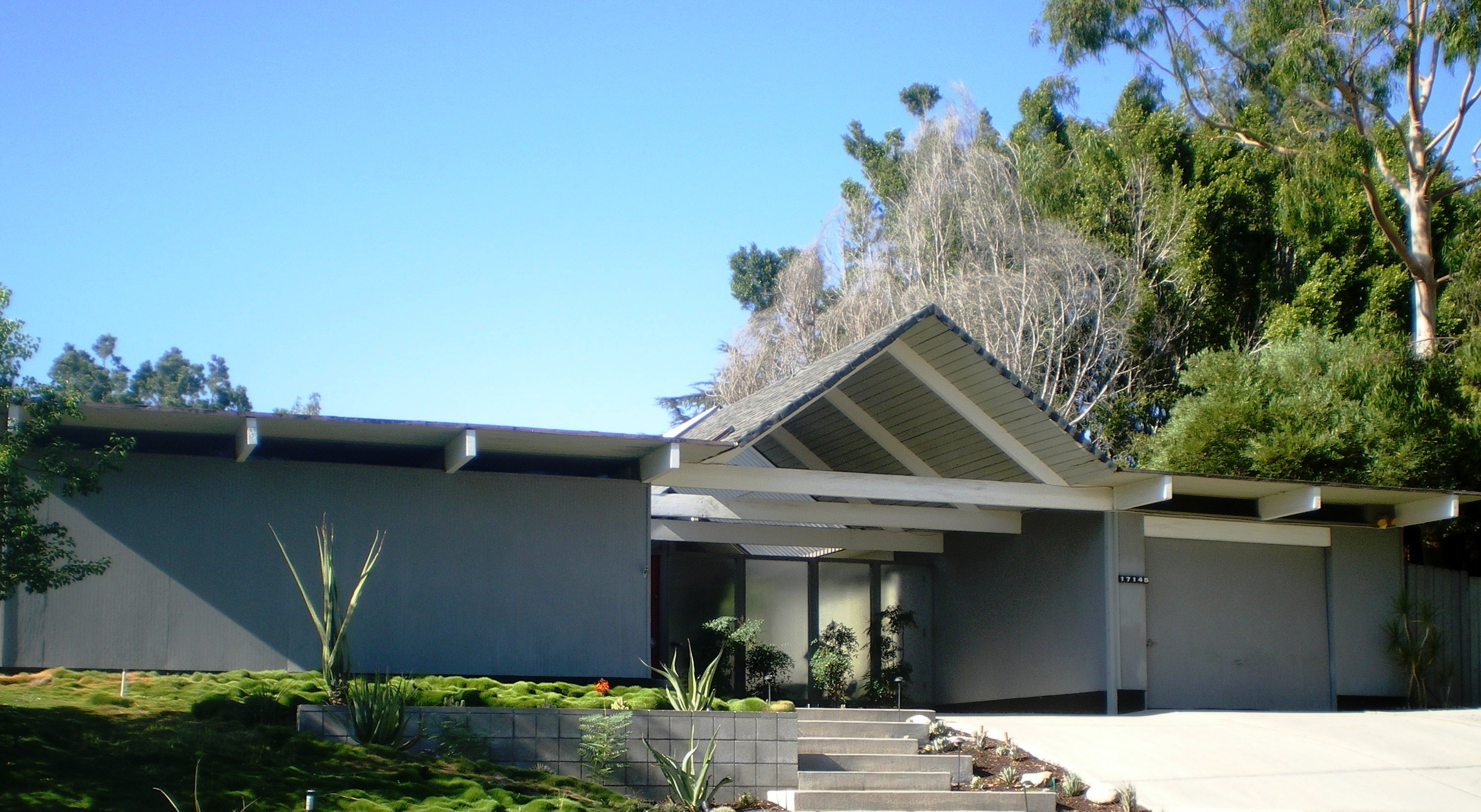
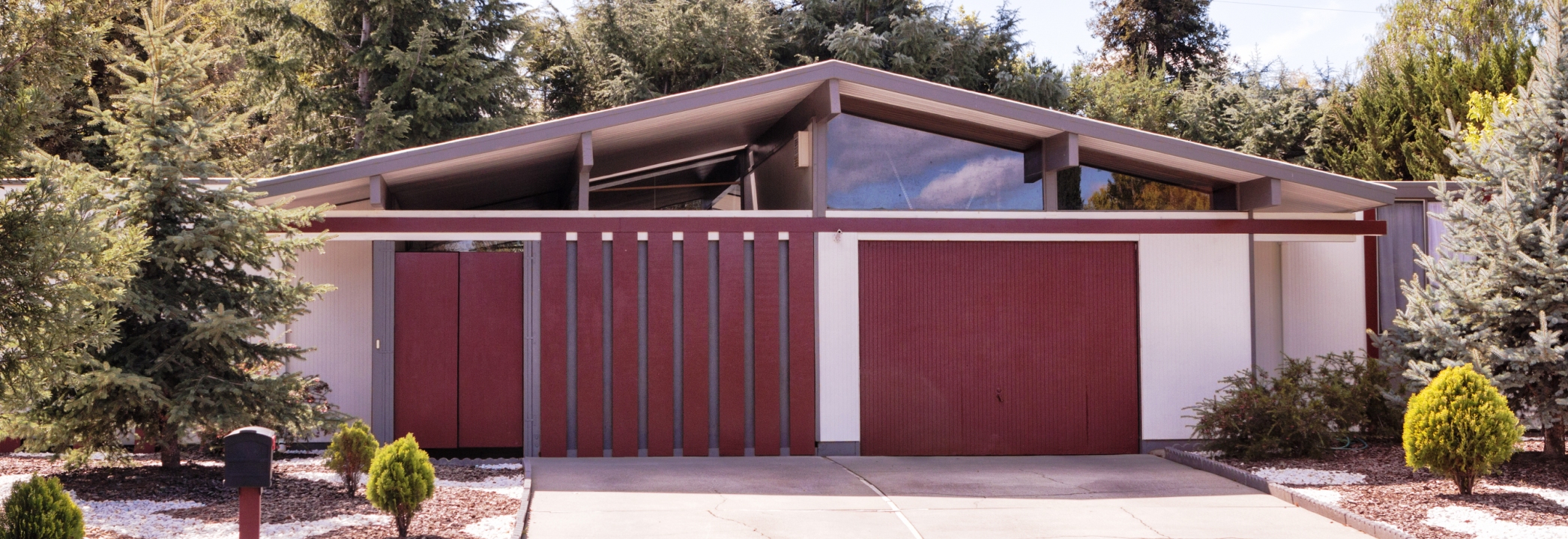
An Eichler home is a mid-century modern residence built by developer Joseph Eichler between 1949 and 1974, defined by post-and-beam construction, floor-to-ceiling glass walls, open atriums, radiant floor heating, and an indoor-outdoor philosophy that remains as captivating today as it was seven decades ago.
Joseph Eichler was not an architect. He was an accountant and developer who, after spending time in a Frank Lloyd Wright–designed home, became convinced that great modern design should be available to working families, not just the wealthy. That conviction produced one of the most distinct and enduring bodies of residential architecture in California history.
The hallmarks are immediately recognizable: a largely closed street-facing facade with small high windows for privacy, an open interior that pours outward to a courtyard or atrium, post-and-beam structural framing that allows walls of glass without load-bearing constraints, a concrete slab floor with hydronic radiant heating embedded below the surface, and a flat or low-slope roof that carries the eye horizontally across the landscape.
Inside, original Eichlers feature mahogany paneling, tongue-and-groove ceilings, exposed structural beams, globe lighting, and a seamless connection between interior and exterior that was truly revolutionary for postwar suburban housing. Eichler's mission included an explicit non-discrimination policy for buyers of any religion or race. That commitment was extraordinary in segregated postwar America.
Eichler Model Types at a Glance
Model Type
Key Features
Common In
Atrium Model
Open-air central atrium with sliding glass doors on multiple sides
Sunnyvale, Palo Alto, San Jose
Carport Atrium
Atrium model with integrated carport entry; very popular floor plan
Widespread across all tracts
Double A-Frame
Two mirrored gable rooflines; dramatic ceiling heights; highly collectible
Sunnyvale (Rancho Sans Souci, Parmer Place)
Single Gable
Single dramatic sloped roofline over living/dining area; earlier era
Sunnyvale Primewood, early tracts
Courtyard / L-Model
L-shaped footprint surrounding a private courtyard; no open-air atrium
Palo Alto, Sunnyvale
Gallery Model
Rare showroom design; elongated open floor plan; used as model homes
Mountain View (Bell Meadows)
Loggia Model
Extremely rare covered loggia entry; only found in specific Sunnyvale tracts
Sunnyvale (Parmer Place)
How Many Eichler Homes Exist? Understanding the Rarity
Joseph Eichler built approximately 10,600 homes over his 25-year career. He concentrated more than 10,000 of them in the San Francisco Bay Area, which makes Northern California, and Silicon Valley in particular, the undisputed center of the Eichler universe and the heart of the resale market today.
The numbers put the rarity in perspective. Across the entire Bay Area, roughly 11,000 Eichler homes exist today.
Palo Alto alone is home to an estimated 2,700, the highest concentration of any city in the country, according to the Eichler Network archive. Sunnyvale has approximately 1,100 homes spread across at least 16 distinct tracts. San Jose, Mountain View, and Cupertino together account for well over 1,000 more.
On the Peninsula, San Mateo's Highlands development is the single largest contiguous Eichler tract ever built anywhere, with more than 650 homes. Marin County adds another 1,700-plus in San Rafael, Mill Valley, and San Anselmo. San Francisco has approximately 600, mostly in condominium developments. The East Bay contributes Walnut Creek's Rancho San Miguel (375-plus homes), Concord, Castro Valley, and Oakland communities.
When you consider that these homes were built between 1949 and 1974 and have never been replicated at scale since, the supply is permanently finite. No more are being built. As a result, the pool shrinks slightly every year as some are torn down or fundamentally altered. Meanwhile, that permanent scarcity, combined with extraordinary design quality, is why Eichler values have held and grown through multiple market cycles.
Pro Tip | Don Orason, SVRET
When a well-preserved Eichler comes to market in a strong tract, the window is narrow, serious buyers know this and prepare accordingly.
Why Is Silicon Valley the Eichler Capital? The Sunnyvale Origin Story
Silicon Valley is the geographic birthplace of the Eichler home. Joseph Eichler built his very first development in Sunnyvale in 1949. That city would become home to over 1,100 Eichler homes across 16 tracts and remains the most historically intact Eichler market in the country.
Eichler chose Sunnyvale because the postwar population boom in Santa Clara Valley was creating urgent demand for quality housing, land was available, and the mild climate made his indoor-outdoor design philosophy immediately viable. The success of those first Sunnyvale Eichler homes validated his vision and launched a building program that would span two and a half decades across the entire Bay Area.
The Sunnyvale connection runs deep in Silicon Valley's cultural history. Apple co-founder Steve Wozniak grew up in a Fairorchard Eichler home on Edmonton Avenue in Sunnyvale. That is the same tract where Eichler first tested his expanded atrium floor plans.
The City of Sunnyvale has adopted official Eichler Design Guidelines, a municipal policy that provides guidance for homeowners undertaking renovations, with the goal of preserving the architectural character that makes these neighborhoods distinctive. It is one of the few cities in the country with such a specific preservation framework for a tract developer's work.
The Three Architects Who Defined the Eichler Legacy
Three architectural firms were responsible for virtually every Eichler home ever built: Anshen and Allen, Jones and Emmons, and Claude Oakland. Each brought a distinct sensibility to the catalog, and knowing which firm designed a home you're considering can significantly affect its collectibility and value.
Anshen & Allen: The Founding Vision
Anshen and Allen established the foundational Eichler design language beginning in the early 1950s. Specifically, their work defined the post-and-beam structural system, the relationship between indoor and outdoor space, and the characteristic privacy of the street facade paired with openness at the rear. As a result, many of the earliest Sunnyvale and Palo Alto tracts bear their signature, and these homes are prized for their connection to the genesis of the style.
Jones & Emmons: The Grand Scale
Jones and Emmons took on Eichler's most ambitious projects, most notably the San Mateo Highlands, the largest contiguous Eichler development ever built. Their work tended toward somewhat more formal proportions and refined detailing. The Highlands HOA remains one of the few active Eichler-specific homeowners associations in the Bay Area, preserving the community character that Jones and Emmons originally designed.
Claude Oakland: The Atrium Era
Claude Oakland became Eichler's principal and most prolific architect from 1959 onward, designing well over 3,000 homes.
Subsequently, Oakland refined and popularized the atrium model, the open-air courtyard at the heart of the home that became the defining feature of the mature Eichler. His Double A-Frame designs, with their two mirrored rooflines and dramatic interior ceiling heights, are among the most sought-after models in the market today. They command a premium. He also designed the Foster City Eichlers, including the distinctive two-story examples that remain the only multi-story Eichler homes in the Bay Area outside of San Francisco.
Pro Tip | Don Orason, SVRET
The architect matters: Claude Oakland's Double A-Frame and atrium models in later Sunnyvale tracts regularly outperform earlier flat-roof designs at resale, and identifying the model type from the floor plan before touring shapes the entire approach to pricing, inspection, and negotiation strategy.
Eichler Homes for Sale by City: Find Your Market
Eichler homes are concentrated in six Santa Clara County cities and five San Mateo County communities, with smaller populations scattered across Alameda, Contra Costa, Marin, and San Francisco counties. The Silicon Valley Real Estate Team specializes in Santa Clara and San Mateo counties, where the vast majority of Bay Area Eichler transactions occur.
Each city offers a distinct market character. Palo Alto is the prestige apex, home to the National Register tracts, the highest prices, and the largest inventory.
Sunnyvale offers the widest range of entry points and the deepest tract diversity, from the earliest 1949 Manor homes to the final Claude Oakland developments of the early 1970s. San Jose's Fairglen, Morepark, and Rose Glen tracts attract buyers seeking slightly more space for value. The Highlands in San Mateo is the only Eichler community with its own formal HOA.
San Mateo County is home to approximately 430 Eichler homes across five cities, anchored by the landmark San Mateo Highlands. Our combined San Mateo County page covers all Peninsula Eichler communities in detail.
San Mateo
Home to the San Mateo Highlands, the largest contiguous Eichler development ever built, with an active Eichler-specific HOA.
Key communities: The Highlands, Nineteenth Avenue Park
Eichler homes exist in several other Bay Area counties. Marin County has over 1,700 Eichlers concentrated in Terra Linda, Lucas Valley, and Marinwood in San Rafael, with smaller communities in Mill Valley and San Anselmo.
The East Bay's largest concentration is Walnut Creek's Rancho San Miguel (375-plus homes), with additional tracts in Concord, Castro Valley, and Oakland's Sequoyah Hills neighborhood. San Francisco has approximately 600 Eichler units, primarily in condo developments. Our team focuses on Santa Clara and San Mateo counties, but we can connect you with trusted colleagues for other Bay Area regions.
What Does an Eichler Home Cost? A Market Tier Overview
Eichler pricing in Silicon Valley spans a wide range depending on city, tract, condition, and model type. Per the most recent MLS data, the market breaks into distinct tiers. Palo Alto and Los Altos sit at the prestige apex, Sunnyvale and San Jose offer broader entry points, and San Mateo County prices reflect Peninsula real estate dynamics.
Understanding the tier structure helps buyers calibrate their search and helps sellers understand how their home is positioned relative to the broader Eichler market. No two Eichler markets behave identically. Tract prestige, condition, and model type all play roles that go beyond raw square footage.
City
Market Tier
Notable Drivers
Palo Alto
Premier
Two National Register historic districts, largest Eichler inventory in the Bay Area, highest price tier region-wide
Los Altos
Premier
Estate-sized lots, luxury land values, buyers treat as architectural estates
Cupertino
High
Fairgrove tract scarcity, limited resale frequency, established neighborhood character
Mountain View
High
Walkable downtown, Monta Loma and Bell Meadows tract character, rare Double A-Frame and Gallery model premium
Sunnyvale
High
Broadest range from entry-level to premium; model type and tract drive variance significantly
San Mateo
High
Peninsula location, Highlands HOA community, Crystal Springs proximity
San Jose
Accessible
Best value for square footage among prime Eichler markets; Fairglen commands neighborhood premium
Santa Clara
Accessible
Pomeroy townhome communities offer lower entry point than detached Eichler homes; single-family inventory limited
For a live view of current pricing and inventory across Eichler homes for sale in any market, use our custom market report tool, which pulls directly from MLS data and updates automatically. You can also use our mortgage calculator to estimate monthly payments at current rates.
National Register of Historic Places: Eichler's Most Storied Tracts
Two Palo Alto Eichler tracts, Greenmeadow and Green Gables, are listed on the National Register of Historic Places, recognizing their exceptional significance in American architectural and social history. No other Eichler development carries this distinction anywhere in the country.
The National Register listing reflects not only architectural merit but also the communities' role in demonstrating a new model for postwar suburban living, one that prioritized design, openness, and inclusivity at a time when most tract housing offered none of those qualities. Greenmeadow and Green Gables represent the mature expression of the Eichler vision, and you can explore all currently available Palo Alto Eichler homes for sale on our dedicated city page.
For buyers, the National Register designation carries practical implications. While listing does not automatically restrict what owners can do with their property, homes in nationally recognized historic districts often face design review requirements for exterior modifications. For sellers, the designation is a powerful marketing asset. It places the home in a context of genuine historical significance that other Silicon Valley real estate cannot claim.
Green Gables in North Palo Alto is particularly notable for its mature tree canopy, carefully preserved street character, and the cohesion of original homes that remain largely intact. Buyers seeking the most historically significant Eichler experience in the Bay Area consistently look here first.
Are There Eichler Townhomes? The Pomeroy Communities in Santa Clara
Pomeroy Green and Pomeroy West in Santa Clara are the only Eichler townhome communities in the Bay Area outside of San Francisco. Both offer the iconic Eichler design language in a setting where exterior maintenance responsibilities are handled collectively through the community association. Built between 1961 and 1963, these communities remain highly sought by buyers who want Eichler character without the full ownership demands of a single-family home.
Both communities feature the characteristic Eichler architecture. Post-and-beam construction, open floor plans, walls of glass, and the indoor-outdoor flow are all present in attached townhome format.
The community association at Pomeroy covers landscape maintenance, exterior upkeep, and shared amenities, varying by community. One note for buyers: Pomeroy Green is organized as a co-op, so confirming lender options early in the process is worth a conversation.
For buyers who love Eichler design but prefer not to manage flat roof maintenance, radiant system repairs, or exterior upkeep independently, Pomeroy represents a strong option. Buyers on a tighter budget also get a lower entry point into the Eichler market compared to single-family homes in Palo Alto or Sunnyvale. Palo Alto has a small number of Eichler townhome units as well.
Inventory in both communities is limited. When a unit comes available, it typically moves quickly. Our townhome and condo search is the fastest way to see what is currently active.
Eichler homes reward informed buyers. The same features that make them architecturally extraordinary, including radiant slab heating, post-and-beam structure, flat roofs, and walls of glass, also create ownership considerations that differ meaningfully from conventional homes. Understanding these before writing an offer protects buyers significantly.
Is Radiant Floor Heating a Problem in Eichler Homes?
Eichler homes were built with hydronic radiant heating systems: hot water pipes embedded in the concrete slab. The system produces exceptional comfort: even, quiet heat with no forced air, no cold spots, no ductwork. When well-maintained, the system is also energy-efficient.
The concerns arise with age. In particular, original copper pipe systems can develop slab leaks, a serious repair requiring either pipe rerouting or slab excavation. Accordingly, always have a radiant specialist inspect the system independently before purchase, including boiler condition, zone valve function, and a leak detection test.
Do Eichler Flat Roofs Require Special Maintenance?
The flat and low-slope rooflines that define Eichler's visual language require more attentive maintenance than pitched roofs. In particular, drainage is critical. Any debris accumulation or drain blockage can lead to ponding water and eventual penetration. Most Eichler roofs are foam or built-up systems with a typical lifespan of 10 to 20 years depending on maintenance.
In addition, budget for periodic inspection and plan for eventual replacement. Silicon Valley has experienced contractors who specialize in nothing else.
Can You Remodel Around an Eichler Post-and-Beam Structure?
The post-and-beam framing system allows Eichlers to have open, light-filled interiors, but it also means that many walls are structural and cannot be removed without significant engineering work. Therefore, before purchasing an Eichler with plans to expand or reconfigure, consult with a structural engineer who has Eichler experience. The City of Sunnyvale's Eichler Design Guidelines and Palo Alto's design review process for historic tracts both provide frameworks for renovation work that respects the original structure.
What Should I Know About Permits and Additions on an Eichler?
Eichler homes have been modified extensively over the decades. Some beautifully, some problematically. Always pull the permit history for any Eichler you're considering.
Unpermitted additions that modify the post-and-beam system or enclose atriums without proper structural support are among the most common issues encountered. Consequently, these can create title, insurance, and resale complications that a thorough pre-purchase review will surface.
Get a general inspection and a radiant system inspection separately from specialists who work on Eichlers regularly, because a radiant specialist will confirm whether the boiler has years left or months, identify active micro-leaks in the slab, and give a realistic cost estimate. That knowledge is the difference between a confident offer and a painful surprise.
Thinking about buying or selling? Our buyers guide and sellers guide cover the full Silicon Valley transaction process. Relocating to the area? Our relocation services page covers everything you need to know before the move.
Why Work With Our Team for Your Eichler Search?
The Silicon Valley Real Estate Team brings deep roots across every Eichler market in Santa Clara County and San Mateo County. When you work with us, you get agents who know these neighborhoods street by street. Not just the listings, but the tracts, the model types, the renovation histories, and the things that never make it into an MLS description.
There is a meaningful difference between an agent who has sold a few Eichlers and a team that has worked these communities extensively across multiple market cycles. Notably, we understand which tracts carry a premium and why. Knowing which floor plans tend to appraise conservatively, we structure an offer that accounts for it. And we can tell when a "lightly updated" Eichler means thoughtfully preserved versus deferred maintenance with a fresh coat of paint.
For sellers, that local knowledge translates directly into how we position your home. The marketing story for a Fairorchard Eichler (birthplace neighborhood, Wozniak connection, original bones) is different from the story for a Rancho Sans Souci Double A-Frame. Still, these distinctions matter to the right buyer, and finding the right buyer is the job. Browse past and current sold Eichler homes to see how the market has moved, or run a foreclosure search if you're looking for distressed inventory.
Our clients have recognized this approach with over 300 five-star reviews. Read their stories at our reviews and testimonials page, then reach out to start your own.
An Eichler home is a mid-century modern residence built by developer Joseph Eichler between 1949 and 1974. Known for post-and-beam construction, floor-to-ceiling glass walls, open floor plans, radiant floor heating, flat or low-slope roofs, and indoor-outdoor atriums, Eichler homes are considered collector-grade architectural gems and consistently command premium prices in Silicon Valley and the Bay Area.
Where are Eichler homes located in Silicon Valley?
Eichler homes are concentrated across Santa Clara County and San Mateo County. The largest markets are Palo Alto, Sunnyvale, San Jose, San Mateo's Highlands development, Santa Clara, Mountain View, Cupertino, Foster City, Redwood City, and Burlingame. Palo Alto holds the highest single-city inventory in the Bay Area, and Sunnyvale is historically significant as the city where Joseph Eichler built his very first homes in 1949.
What architects designed Eichler homes?
Three architectural firms defined the Eichler catalog. Anshen and Allen designed the earliest tracts and established the post-and-beam design language. Jones and Emmons contributed refined floor plans and designed the landmark San Mateo Highlands. Claude Oakland became Eichler's most prolific architect from 1959 onward, designing over 3,000 homes including the iconic atrium and Double A-Frame models.
How many Eichler homes exist in the Bay Area?
More than 10,000 of the approximately 10,600 homes Joseph Eichler built over his 25-year career were constructed in the San Francisco Bay Area. Palo Alto holds the highest single-city concentration, followed by Sunnyvale as the second-largest market in Santa Clara County. No new Eichler homes have been built since 1974, making the existing supply permanently finite.
What makes Palo Alto Eichlers special?
Palo Alto is home to the largest concentration of Eichler homes in the Bay Area and includes two National Register of Historic Places districts: Greenmeadow and Green Gables. Per the most recent MLS data, Palo Alto Eichlers consistently command the highest prices in the region, reflecting the architectural prestige and historic designation of these communities.
Are there Eichler townhomes for sale?
Yes. Santa Clara is home to Pomeroy Green and Pomeroy West, the only Eichler townhome communities in the Bay Area outside San Francisco. These planned communities feature classic Eichler architecture in a community association-managed setting. Pomeroy townhomes typically offer a lower entry price point than single-family Eichler homes while maintaining the architectural character the style is known for.
What is the San Mateo Highlands?
The San Mateo Highlands is the largest contiguous Eichler development ever built, designed primarily by Jones and Emmons. Located in San Mateo on the Peninsula, it features its own homeowners association, one of the few Eichler-specific HOAs in the Bay Area, situated near Crystal Springs Reservoir and Sawyer Camp Trail.
What should I know before buying an Eichler home?
Key considerations include: the radiant floor heating system requires specialized inspection and maintenance; flat roofs need regular attention and periodic replacement; post-and-beam construction restricts certain wall removals; and large glass walls may need upgrading for energy efficiency. Always use an inspector with specific Eichler experience, and request a separate radiant system inspection from a hydronic heating specialist.
Can you remodel an Eichler home?
Yes, and thoughtfully renovated Eichlers frequently achieve significant premiums at resale. Remodels must respect the post-and-beam structural system. The City of Sunnyvale has adopted formal Eichler Design Guidelines to preserve the architectural character of these homes. In Palo Alto's nationally designated historic tracts, certain exterior modifications may require design review.
What are the most desirable Eichler tracts in Sunnyvale?
Sunnyvale's most sought-after tracts include Fairbrae and Fairbrae Addition, Fairorchard (the historic tract where Steve Wozniak grew up), Rancho Sans Souci and Parmer Place (known for larger floor plans and the Double A-Frame model), and Primewood (10 distinct floor plans on generous lots). Per the most recent MLS data, homes in these tracts move quickly when priced accurately.
How do I find Eichler homes currently for sale?
Our IDX search pulls directly from MLSListings and MetroList, updated every 15 minutes. Listings appear consistently earlier than on third-party portals. Use our advanced property search to filter specifically for Eichler homes by city, ZIP code, price range, or bedroom count, and set up instant listing alerts.
What should I look for in an Eichler home inspection?
A thorough Eichler inspection covers radiant heating system condition including boiler age, zone valves, and slab leak detection; flat roof condition and estimated remaining lifespan; post-and-beam structural integrity; original mahogany paneling and tongue-and-groove ceiling condition; glass wall seals and sliding door hardware; and any unpermitted modifications. Always use a general inspector and a separate radiant system specialist.
What is radiant floor heating and how does it work in an Eichler?
Eichler homes were built with hydronic radiant floor heating: a network of hot water pipes embedded in the concrete slab beneath the living space. A boiler heats water that circulates through the pipes, warming the slab and radiating even, gentle heat upward. The system is remarkably comfortable and energy-efficient when properly maintained. It requires periodic boiler servicing and may need slab leak repair as systems age.
Ready to Find Your Eichler?
Search live listings, get an instant home value estimate, or connect directly with Don Orason and our team.
The data relating to real estate for sale on this website comes in part from the Internet Data Exchange program of the MLSListings™ MLS system and the MetroList® MLS. Real estate listings held by brokerage firms other than Silicon Valley Real Estate Team are marked with the Internet Data Exchange icon. All data, including all measurements and calculations of area, is obtained from various sources and has not been, and will not be, verified by broker or MLS. All information should be independently reviewed and verified for accuracy. Data deemed reliable but not guaranteed. DRE# 01319840.
The data relating to real estate for sale on this display comes in part from the Internet Data Exchange program of the MLSListingsTM MLS system. Real estate listings held by brokerage firms other than Real Estate Company are marked with the Internet Data Exchange and detailed information about them includes the names of the listing brokers and listing agents. Based on information from MLSListings MLS as of . All data, including all measurements and calculations of area, is obtained from various sources and has not been, and will not be, verified by broker or MLS. All information should be independently reviewed and verified for accuracy. Properties may or may not be listed by the office/agent presenting the information.
All measurements and all calculations of area (i.e., Sq Ft and Acreage) are approximate. Broker has represented to MetroList that Broker has a valid listing signed by seller authorizing placement in the MLS. Above information is provided by Seller and/or other sources and has not been verified by Broker. Copyright 2026 MetroList Services, Inc. The data relating to real estate for sale on this web site comes in part from the Broker Reciprocity Program of MetroList® MLS. All information has been provided by seller/other sources and has not been verified by broker. All interested persons should independently verify the accuracy of all information. Last updated .
By continuing to use this site, you consent to our use of
technologies that analyze and monitor activity on our website, may record your activity on this site, and
sometimes provide you with tailored advertising. You also consent to our
Privacy Policy and Terms & Conditions